
Life Isn’t Always Fair…So We Choose Compassion
This past Christmas and New Year’s unfolded in the shadow of Hurricane Melissa. For many Jamaicans, the aftermath was devastating: some were left staring at the sky where their roofs once stood, surrounded by the soaked wreckage of their homes. Others saw their farming livelihoods wiped out, and still others were cut off without essential services like electricity, water, or communication. Environmental experts suggest that the severity of this hurricane is linked to the careless global warming contributions of other countries. The reality is that we sometimes witness others appearing to glide through life on smooth pavement while we struggle, navigating potholes in worn-out shoes. It is in a quiet moment like this that Jamaican wisdom offers its profound observation:
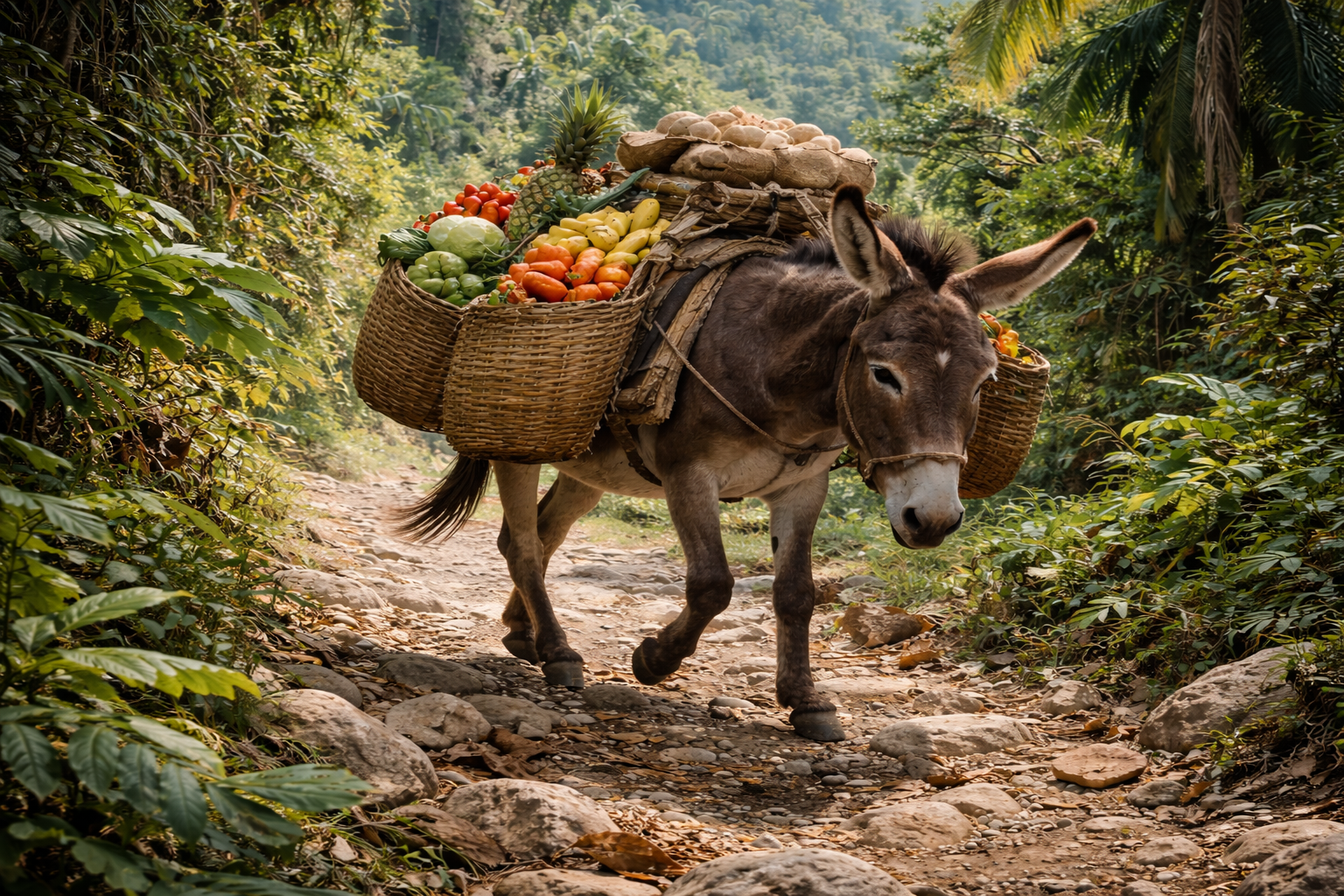
“Jackass say di worl’ nuh level.”
The donkey says the world is not flat. Simple as that. Life is uneven, unfair, and unpredictably tilted. Some people start ten steps ahead. Some are born already climbing uphill. Some trip before they even learn their footing.
This proverb doesn’t dress up the struggle or pretend injustice doesn’t exist. It just names reality without getting bitter about it, and it refuses to let despair win. My father says this one a lot, usually with a sigh and a shake of his head after witnessing something that just isn’t right.
Teaching Children About an Uneven World
In Jamaican culture, we don’t pretend the world is gentle. Children notice when their classmates have more than they do. They feel it when their effort doesn’t bring the same rewards. Parents feel it too – stretching meals, improvising school supplies, still worrying it’s not enough. “Jackass say di worl’ nuh level” becomes a quiet way to teach. We don’t lie to our children about fairness, but we also don’t teach them to be resentful. Instead, we teach resilience with dignity. We teach that effort matters even when the outcomes are different. We teach that your worth isn’t measured by what you inherited or where you started. And most importantly, we teach that nobody has to walk alone unless we let them.
Softening Judgment in Relationships
In relationships, this proverb helps us judge less harshly. Every adult is carrying invisible stories; childhoods shaped by scarcity or comfort, trauma or tenderness, abandonment or love. Two people can arrive at the same argument from completely different emotional roads. When we forget that, we get sharp with each other. When we remember it, we get curious instead. Love grows up when we stop demanding that everyone respond to life from the same starting point. Compassion deepens when we ask, “What hill are you climbing that I can’t see?”
Building Equity at Work
At work, this becomes a quiet leadership principle. Not everyone has equal access to mentorship. Not all confidence grows in safe soil. Some employees learned early how to speak up; others learned survival meant staying invisible. “Jackass say di worl’ nuh level” pushes managers to build equity instead of hiding behind equality. It asks leaders to notice who gets overlooked, who lacks sponsorship, who works twice as hard for half the visibility. In workplaces, this shows up in small but meaningful ways: sharing information instead of hoarding it, pulling someone into a room they were never invited to, making space at tables that used to feel closed.
From Complaint to Responsibility
The beautiful thing about this proverb? It doesn’t end in complaint. It ends in responsibility. If the world isn’t level, then our job becomes making it gentler wherever we can. The response to unfairness isn’t bitterness. It’s generosity with boundaries. It’s speaking truth without spite. It’s choosing humanity over hardness.
You see this spirit in Jamaican community life all the time. One pot still feeds more than one mouth. Christmas barrels still show up where money is tight. Someone always “passes through” with extra food. Even people with little still find ways to share. The uneven world doesn’t stop the flow of care; it often makes it stronger.
Living the Proverb
To live this proverb meaningfully, we start by seeing honestly. Notice who’s carrying more. Examine the privileges you might pretend you earned all on your own. Soften your assumptions. Give help without making people feel ashamed. Ask better questions. Interrupt your own quick jumps to judgment. And when you’re the one struggling uphill? Let yourself receive help without apologizing for it.
Further Reading
A few powerful books echo this proverb’s spirit. All About Love by bell hooks reminds us that justice without love just becomes another form of cruelty. Louise Bennett-Coverley’s poetry, especially in Selected Poems, preserves the dignity of everyday Jamaican life with humor and deep respect. And Viktor Frankl’s Man’s Search for Meaning teaches how purpose survives even on the most uneven terrain.
A Grounding Truth
In the end, “Jackass say di worl’ nuh level” isn’t a sentence of defeat. It’s a grounding truth that frees us from illusion. The world may not be flat, but our compassion can be steady. Our kindness can be consistent. Our refusal to dehumanize each other can become its own kind of leveling force.
So here’s the gentle invitation: Today, notice one way the road tilts for someone else. Offer a hand without needing applause. Speak with kindness where silence would be easier. Live the proverb quietly and faithfully.
Leave a Reply