
Why Your Best Moments Deserve Your Sharpest Attention
There is a particular kind of joy that Jamaicans know how to inhabit fully. You may have seen it at a lyme or session when the bass from the sound system is deep enough to feel in your chest. You may have sensed it as curried goat, jerk chicken, and rice and peas were passed around at family gatherings where siblings ‘card’ each other or laugh over special memories. Jamaicans know how to be merry. And this proverb, in the gentlest possible way, suggests that we remain attentive even as we celebrate life’s moments.
What the Proverb Actually Says
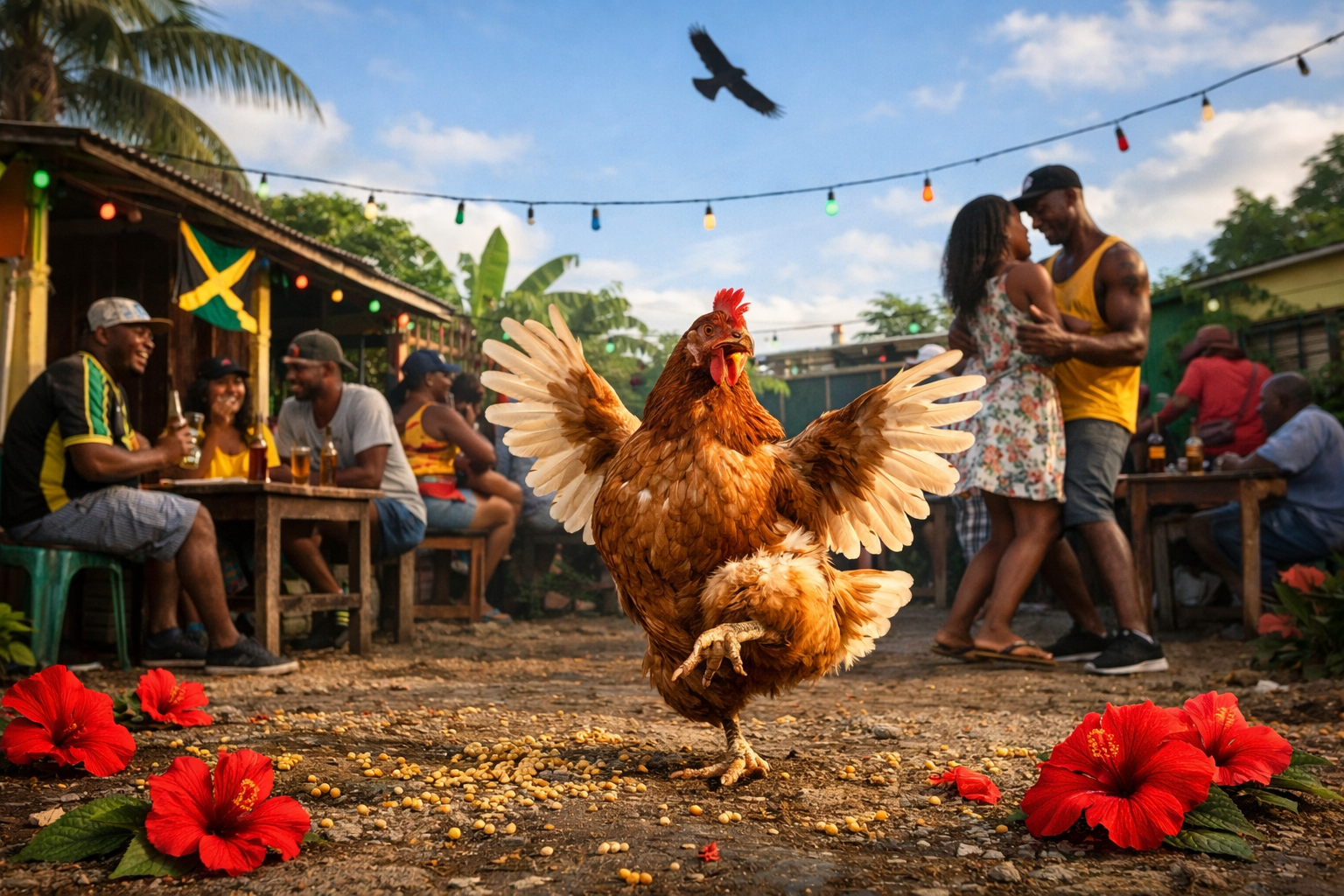
Chicken merry, hawk deh near. The chicken is dancing. The chicken has eaten, the afternoon is warm, and life is good. What the chicken has not noticed is the shadow circling quietly above.
The hawk is not in a hurry. It has no reason to be. It is simply waiting for the moment when the chicken is most fully absorbed in its happiness to make its move.
This proverb is not a warning against joy. It says understand what company your merriness sometimes attracts. Joy and vigilance are not opposites. This proverb holds them together.
At Home: The Price of Letting Your Guard All the Way Down
Think about the moments in a family’s life when things fall apart. They are not necessarily the hard moments. It is the good periods that sometimes catch families off guard.
The family that is flourishing may stop having the hard conversations because things are going well. The couple celebrating a milestone year may stop doing the daily work of intimacy because the relationship feels secure. The parent proud of a child’s achievements may stop paying close attention to what else is happening in that child’s life.
The hawk does not announce itself. It is drawn to the gap in awareness that celebration sometimes creates. Merry is beautiful. Stay merry. Just glance up every so often.
In Relationships: When Success Makes You Soft
There is a reason some of the hardest seasons in a relationship come after a breakthrough. When you get the promotion, when the mortgage finally gets paid, when the children leave home and the two of you have space to breathe again, that is sometimes the moment the ground shifts in ways you did not anticipate.
New circumstances bring new vulnerabilities. New visibility brings new attention, not all of it well-intentioned. New freedom brings new temptations. None of this should cause fear or paranoia. But it should make you wise. Check in with your people. Keep the conversations honest. Do not assume that because everything looks good, nothing needs tending.
At Work: The Danger of a Comfortable Quarter
In the professional world, the hawk wears many disguises. It might be a competitor who has been watching your business grow and quietly making plans. It might be a team member whose loyalty you assumed because things were going well. It might be an internal complacency that settles in when the numbers are good and the pressure eases.
Leaders who only manage through difficulty are not leading. They are reacting. The most effective people manage vigilance the same in good seasons as in hard ones. They do not assume that a good quarter is a guarantee of a good year. They stay curious. They keep asking questions. They resist the temptation to stop looking up simply because the sky is clear right now.
The chicken dancing in the yard is not doing anything wrong. The only thing it needs to add to its dancing is one glance skyward. That is the whole lesson.
Practical Ways to Live This Proverb
Schedule a monthly review of what is going well and what might be quietly building pressure beneath the surface. This does not need to be formal. A conversation over dinner, a journal entry on Sunday morning, a question to your business partner over coffee. The goal is simply to create the habit of looking up.
In relationships, resist the impulse to coast on goodwill. Regular honest check-ins, the kind where you actually ask how the other person is doing and stay for the real answer, are a form of vigilance that love requires.
In your finances, the good months are when your savings should grow the most. Do not let abundance create permission to be careless. The hawk particularly circles people who have just started to feel safe.
Practise gratitude and awareness together. They are not enemies. In fact, genuine gratitude requires you to pay attention to what you have. Paying attention is itself a form of protection.
From the Bookshelf
Two books sit companionably alongside this proverb.
Closer to home, Earl Lovelace’s The Dragon Can’t Dance is a novel steeped in the Caribbean rhythms of celebration and the cost of not seeing clearly. His characters live fully and sometimes recklessly, and the book honours both the joy and the price of that. It is the kind of story that stays with you.
For poetry, Claudia Rankine’s Don’t Let Me Be Lonely carries this same double awareness of beauty and threat in a world that does not always signal its dangers in advance.
A Closing Thought
The chicken is not wrong to be merry. Do not let anyone talk you out of your joy.
But joy that is fully alive is also alive to its surroundings. This proverb is encouraging us to dance with both feet on the ground and our eyes sometimes turned upward.
What area of your life is merrier right now than usual? Take just a moment this week to look up and ask: what else is nearby that I have not been paying attention to?
Leave a Reply